Ivan FedyuninSenior software engineer
Menu

Ivan Fedyunin,Senior software engineer

· LLM systems, data pipelines, agent-first development

I've been building backends for 15 years. For clients, my AI work has mostly been data: scrapers and LLM pipelines that turn messy documents into searchable data. HostelPunk is where I went deeper, with labeled evals, small models replacing LLM calls, and local inference. Now I want AI to be the main thing I work on.

Since Claude Opus 4.5 came out in November 2025, agents write pretty much all of my code. I learned to make that work on HostelPunk and at Oversize.io. Both needed far more than I could build by hand, so the agents had to work without messing up the codebase and without me checking everything after them. I keep learning which models can do what, which workflows hold up, and how to turn a hard, vague problem into something agents can solve on their own. I hate boring work and agents are great at it, so these days I pretty much only do the fun parts.

Santiago, Chile · Remote · US time-zone overlap · Fluent EnglishOpen to permanent roles and contract projects.

HostelPunk

A hostel search engine. It ranks hostels by what guests write about meeting people and having fun, and AI does all the reading.

Dataset and infrastructure

Figures as of September 2026.

Normalized review corpus
74 million reviewsNormalized from four sources. Not all are analyzed or used in rankings.
Cross-provider catalogue
22,600 matched propertiesOne internal record per property after linking provider listings.
Implemented analysis
235 versioned signalsDefined analysis outputs, such as a mention of social atmosphere or an incentive for a review. Not all apply to every property.
Shared hosting
US$20/month serverThe whole bill for a bare-metal server shared with other projects. Model inference runs on local hardware.
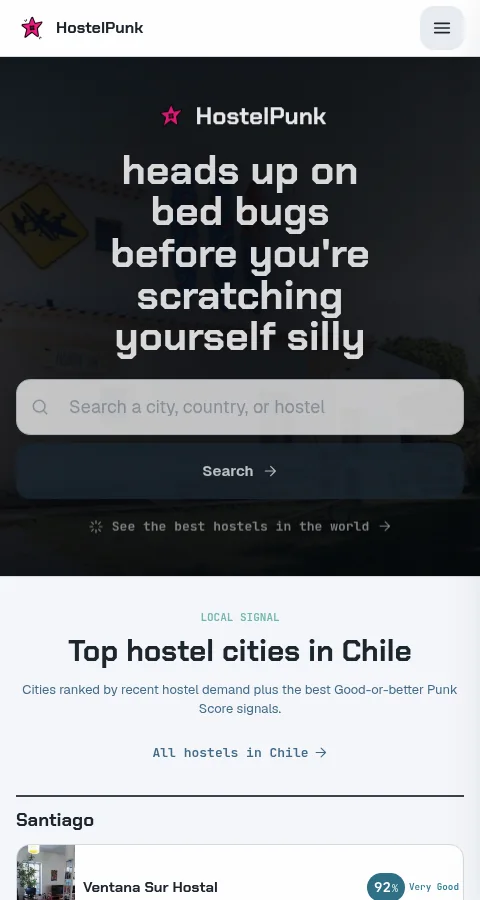
HostelPunk homepage with hostel search and destination rankings
HostelPunkHomepage captured August 1, 2026
Production data path
  1. Source dataReviews and listings

    Guest reviews and property records with inconsistent identifiers and formats.

  2. AcquisitionPython workers

    Scraping, ingestion, and normalization. Each provider needs its own handling.

  3. ResolutionPostgreSQL/PostGIS

    One shared catalogue built from conflicting property listings.

  4. AnalysisLLMs, classifiers and rules

    Review analysis checked against evaluation datasets, with versioned methods and per-result provenance.

  5. ProductGo and HTMX

    Public and admin backends for the live product.

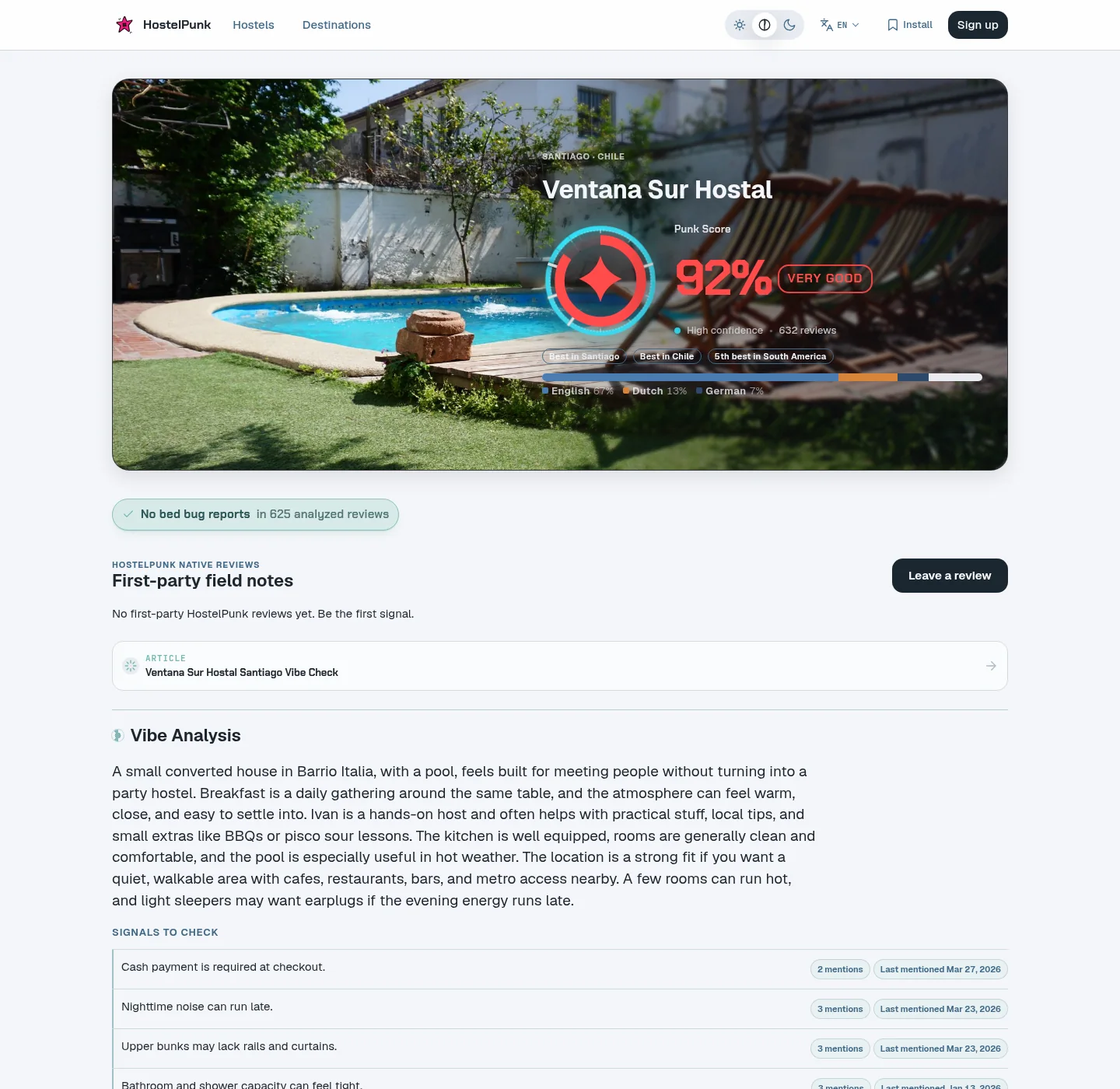
HostelPunk hostel page with a Punk Score, review analysis, warnings, and dated evidence signals
Ventana Sur Hostal, captured August 1, 2026. The live result can change.Open current result⁠

When a classifier replacement failed evaluation

Reducing repeated LLM work makes review analysis cheaper to run. The choice is whether to keep the existing analysis or replace selected tasks with a smaller classifier.

In a May 25, 2026 evaluation, a new classifier scored 0.520 macro F1 across eight signals on the labeled reference set, versus 0.707 for the existing stored outputs. The release review rejected that replacement.

The larger training corpus still had too few usable examples of rare review-manipulation signals.

Evaluation details · plain text⁠

Experience

Selected paid work. The full history is in my CV.

Oversize

2022 to 2026 · Contract

Five products

The founder first hired me to move his apps off Heroku onto bare metal, which also made deploys about 10x faster. After that I worked across five of his products.

  • Built an LLM pipeline that turns PDFs and HTML from hundreds of government sites into searchable PostgreSQL sections, with full text and vectors.
  • Used AI to add scrapers for 2 to 20 new websites a day.
  • Built an EV recommendation site for Chile. It matches each car across local and international sources and ranks them by five-year cost.
  • Built speech-data pipelines for a pronunciation app, 3.7M+ labeled records, and hooked up speech-to-IPA models.

Stack: Python, Ruby on Rails, PostgreSQL

Infrastructure consulting

2025 to 2026 · Parallel contracts

Various clients

I set up and ran bare-metal servers with monitoring, firewalls and backups, and built deployment pipelines client teams could run themselves.

Stack: Linux, systemd, nginx

ExamSuccess

2016 to 2024 · Part-time contract

Education platform

Eight years as the main developer of an Australian education platform. I built its practice-question system in 2019, and learners submitted 2.2M answers by mid-2022.

Stack: Ruby on Rails, PostgreSQL

Jualo

2018 · Contract alongside ExamSuccess

Marketplace

I reduced response times on high-traffic pages roughly 10x through caching and query improvements, on a marketplace serving 4M+ monthly users.

Stack: Rails, PostgreSQL, Redis

Vestuario Antiguo

Photo pipeline · Part-time · 2025-present

Vestuario Antiguo is a fashion atelier in Santiago. DINOv2 matches studio photos to garments, Grounding DINO crops them, and an LLM writes the listing. A shoot turns into draft listings in under an hour. A Lightroom plugin and a small Go tool move photos between the site and Lightroom for retouching. The models run on a workstation, and I picked them by benchmark.

This fashion atelier in Santiago designs, makes, sells and rents dresses and suits. I also take most of their product, promotional and press photographs.

Vestuario Antiguo website with its identity, clothing catalogue, and booking actions

How I work with agents

  • I run several Codex and Claude Code sessions at once in my own fork of T3 Code, an app for driving coding agents. Agents made about 50 changes to it in three weeks, from CLI-style keyboard control to a benchmark of WebSocket against WebTransport on bad networks. I also built claudex-limits to keep an eye on usage limits, and got a PR merged into Herdr, a coding-agent runtime.
  • Before a big feature gets built, agents on different models review the spec and question each other until it's clear. The plan and my decisions go into Git with the reasons.
  • Tests come from a separate session, so they don't share the implementation's blind spots. Fuzz targets are cheap now, so agents write those too.
  • Reviewing agents check the work. One noticed the implementing agent had skipped a database regression test, and ran it.
  • The more a mistake would cost, the more models check the change. For UI work, agents write browser tests that record video.

Work sample and technical writing

Go/PostgreSQL backend exercise⁠

My implementation of Fintual's Backend/DevOps interview exercise: API behavior tests, SQL optimization and documented benchmarks comparing a Django service with a Go implementation. Browse the code, decisions and measurements on GitFront.

I also contribute to open source, including Herdr, a coding-agent runtime.

Contact

I'm in Santiago, Chile, and work remotely with US time zone overlap. I'm looking for AI work at small teams that build with agents.